
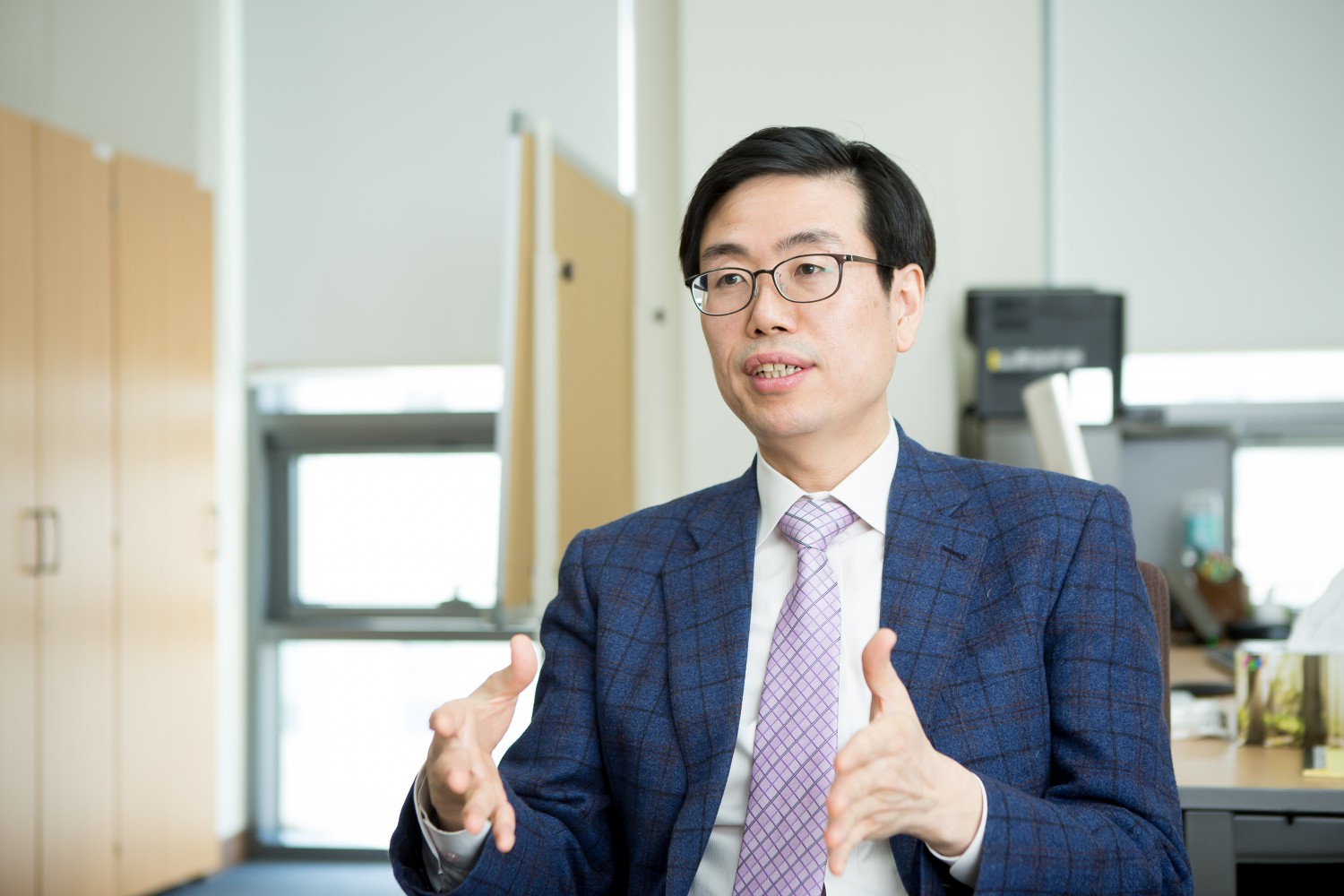
Jaesung Hong has been an Associate and Full Professor of Robotics and Mechatronics Engineering at DGIST, Korea since 2010. His research primarily focuses on surgical AR/VR and surgical robotics. Fundamentally, he is interested in the integration of vision and robotics technologies for clinical applications. He received his B.S. and M.S. degrees in Electronic Engineering from Kyungpook National University, Korea, and his Ph.D. in Frontier Sciences from The University of Tokyo, Japan, in 2004. After obtaining his Ph.D., he worked as a Foreign Researcher of the Japan Society for the Promotion of Science (JSPS), funded by the Japanese government, at The University of Tokyo, and as an Associate Professor at Kyushu University, Japan. He is currently a Professor in the Department of Robotics and Mechatronics Engineering at DGIST, Korea.
As of March 2025, Dr. Hong has published 63 peer-reviewed journal papers indexed in SCIE by Clarivate. Among them, 28 papers were ranked in the top 25% (Q1) in each category, and 38 papers were published as the first or corresponding author. He has registered 47 patents, including 4 US and 1 Japan patents. His most cited article, “An ultrasound-driven needle insertion robot for percutaneous cholecystostomy,” was presented at MICCAI 2004 and published in Physics in Medicine & Biology in 2004, with over 360 citations. While working at Kyushu University Hospital, Japan, he developed original ENT, abdominal, neurological, and dental surgical navigation systems based on 3D Slicer open-source software, and clinically applied them to various surgeries for more than 200 patients. Among them, the dental implant navigation software has been commercialized in Japan and Korea as an approved medical device. He also developed AR-based surgical navigation and applied it to bone tumor surgeries for the first time in Korea, which was featured in more than 40 newspapers.
Dr. Hong has received highly competitive research grants in Korea and Japan. During his junior faculty career at Kyushu University in Japan, he succeeded in obtaining multiple individual research grants, KAKEN funded by the Japanese government, including WAKATE-A and HOUGA grants. During his professor career at DGIST, Korea, he received competitive individual research grants such as NRF-JUNGYEON (Type 1) funded by the Korean government. He has carried out 11 Korean government research projects and 5 local government or industry projects, mostly as Principal Investigator. As of March 2025, the total research funding he has raised while working at DGIST is about 5.7 billion KRW (4.8 million USD). Through national group projects, two surgical robot systems have been commercialized in Korea, one of which, a Brain Stereotactic Surgery robot developed by Koyoung Inc., has recently cleared FDA approval in the US.
He has supervised 17 Master’s students and 8 Ph.D. students to completion. Among them, one is now a tenuretrack Assistant Professor at the Korea University of Technology & Education (KOREATECH), established by the Korean government. Four are tenure-track Senior Researchers at national research institutes in Korea, such as the Korea Institute of Machinery and Materials (KIMM). Additionally, nine are senior researchers in industry, including at SAMSUNG Medicine and POSCO DX.
Since 2011, he has served as a program committee member for Computer-Assisted Radiology and Surgery (CARS), and since 2019, as a program committee member for the Hamlyn Symposium on Medical Robotics. He served as co-chair of the IEEE RAS Technical Committee on Surgical Robotics from 2017 to 2020. Since
2010, he has been appointed as Senior Vice President (President-elect) of the Korean Society of Medical
Robotics (KSMR) for 2025 and 2026. As the General Chair, he hosted the 20th Asian Conference on Computer-
Aided Surgery (ACCAS) in 2024. He is also a Program Chair of Medical Imaging Computing & ComputerAssisted Surgery (MICCAI) 2025. He served as an Associate Editor for the IEEE RA-L Journal in 2015 and 2016, and for Computer Assisted Surgery since 2022. He has given keynote or invited talks at 23 international conferences and symposiums, including UK Robotics Week, IET International Robotics Showcase 2016, and IROS workshops in 2016 and 2019.
He has received 14 paper and presentation awards, including the Best Paper Award of the International Conference on Advanced Mechatronics (ICAM) 2010, the Olympus Best Paper Award of the International
Society of Computer-Assisted Surgery (ISCAS) at CARS 2011, and the Best Video Presentation Award at the Augmented Reality & Surgical Guidance Workshop in the Hamlyn Symposium on Medical Robotics (HSMR) 2013